
Automated Pallet Storage System vs Shuttle Racking: Which Fits High-Throughput Warehouses?
High-throughput warehouses rarely struggle with one issue alone. Space pressure, labor availability, order velocity, and system uptime usually collide at the same time. That is why the choice between an automated pallet storage system and shuttle racking matters far beyond storage layout. It shapes replenishment speed, inventory visibility, forklift traffic, and the long-term economics of warehouse automation.
Both solutions are built for fast-moving pallet flows, yet they solve different operational problems. An automated pallet storage system is designed to reduce manual travel and coordinate pallet movement through software-controlled handling. Shuttle racking, by contrast, focuses on dense lane storage with semi-automated or automated shuttle movement inside the rack. In practice, the better option depends on SKU behavior, batch profiles, service levels, and expansion plans.
Why this comparison is gaining attention
Warehouses linked to e-commerce, manufacturing, retail distribution, and cold chain operations are being asked to move more pallets in less time. At the same time, building costs, labor risk, and energy efficiency have become investment-level concerns.
This is where MHLS-style analysis becomes useful. Material handling decisions no longer sit in isolation. They connect with forklifts, conveyors, WCS software, robotics, safety compliance, and total cost of ownership.
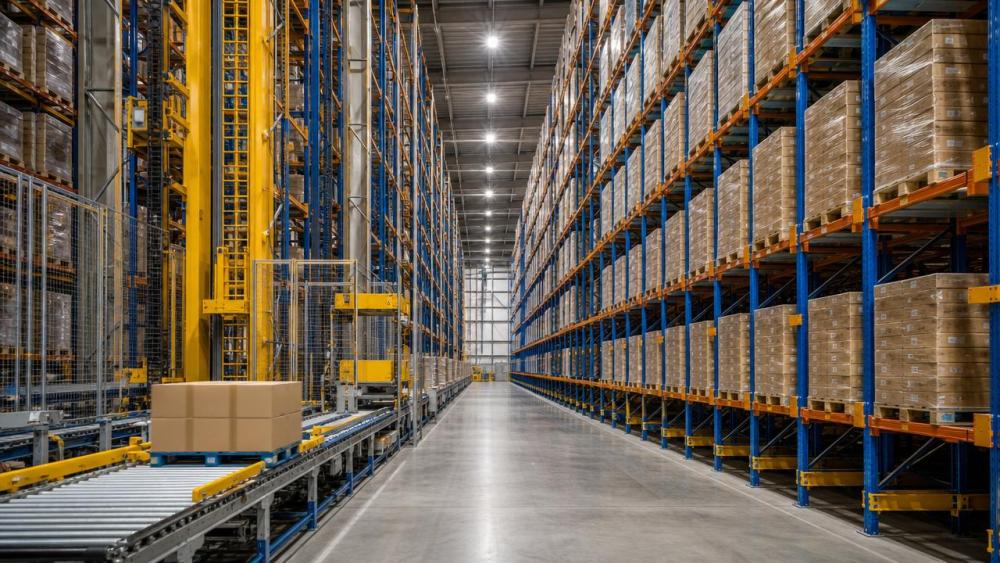
A warehouse choosing between shuttle racking and an automated pallet storage system is not just selecting racks. It is deciding how pallets enter, buffer, store, retrieve, and feed the wider intralogistics system.
What each system really does
Automated pallet storage system
An automated pallet storage system typically combines storage structure, pallet-moving equipment, sensors, and control software. It may use stacker cranes, shuttles, conveyors, lifts, or transfer cars, depending on building height and throughput requirements.
Its key strength is orchestration. The system can route pallets automatically, reduce waiting time between process steps, and integrate directly with WMS or WCS platforms for real-time control.
Shuttle racking
Shuttle racking uses a motorized shuttle to move pallets inside deep storage lanes. Forklifts or transfer systems place the shuttle and pallets at the lane entrance, and the shuttle carries the load inward or outward.
Its core value is storage density. By reducing aisles and supporting deep-lane storage, it can hold a large pallet volume in a smaller footprint than many conventional rack designs.
The difference is less about automation labels
It is tempting to compare the two by asking which one is more automated. That question is too shallow. A better question is how much movement intelligence the operation needs.
A shuttle racking installation can be highly effective where pallet flows are repetitive, lane logic is clear, and SKU turnover is predictable. A fully automated pallet storage system becomes more attractive when routing complexity rises.
That complexity may come from mixed SKU volumes, frequent replenishment, sequencing rules, temperature zones, or strong pressure to reduce forklift dependence.
Performance factors that matter in high-throughput sites
This comparison explains why the automated pallet storage system is often selected for integrated automation projects, while shuttle racking remains attractive for density-driven storage with strong but narrower flow patterns.
Where an automated pallet storage system creates stronger value
The automated pallet storage system usually performs better when storage is only one step in a broader automated process. That includes receiving buffers, production feeding, sequenced dispatch, and outbound wave preparation.
It also becomes more compelling when visibility matters. Software-controlled pallet locations, movement history, and exception handling help reduce search time and improve inventory discipline.
In cold storage, the value can be even clearer. Less manual travel means lower exposure to harsh environments, more stable cycle times, and better use of expensive cubic space.
- High SKU variation with frequent inbound and outbound moves
- Integration with conveyors, sortation, or robotic palletizing
- Tight traceability requirements and live inventory control
- Pressure to reduce forklift traffic and safety exposure
Where shuttle racking often makes more sense
Shuttle racking is often the practical choice when pallet volumes are high, SKU count is manageable, and lane-based logic fits the operation. Food, beverage, frozen goods, and reserve storage environments commonly match this profile.
It supports FIFO or LIFO designs, depending on the layout. That flexibility matters when shelf life, batch rotation, or loading rhythm shapes storage strategy.
Shuttle racking can also offer a more accessible first step into automation. It improves density and reduces deep-lane forklift travel without requiring a full automated pallet storage system from day one.
The hidden costs behind the headline ROI
ROI is often discussed in terms of labor savings and pallet capacity. Those metrics matter, but they do not tell the whole story.
An automated pallet storage system may require higher upfront investment, software integration effort, and stronger commissioning discipline. Yet it can unlock savings in error reduction, labor stability, throughput consistency, and building utilization.
Shuttle racking may look simpler financially, but its economics depend on lane utilization, pallet uniformity, maintenance access, and the number of shuttles needed during peak periods.
The more relevant calculation is total operating fit, not just capital cost. MHLS often frames this through TCO thinking: equipment, controls, maintenance, energy, uptime risk, and future change requirements.
Questions worth settling before choosing
A strong decision usually comes from process mapping, not from product comparison alone. The warehouse should be studied as a flow system.
- How many pallets move per hour at normal and peak conditions?
- How many SKUs share the same storage zone?
- Are pallets standard in size, weight, and quality?
- Will the system connect to WMS, WCS, conveyors, or AGVs?
- Is the site trying to save floor space, labor, or both?
- How likely is a future change in channel mix or building footprint?
If the answers point to mixed flows and high control needs, an automated pallet storage system usually gains the edge. If they point to dense, repeatable pallet buffering, shuttle racking may be the better fit.
A practical way to move forward
The most useful next step is to compare both options against real operating data, not brochure assumptions. Start with pallet profiles, hourly movement peaks, SKU concentration, and service-level targets.
Then examine how each option interacts with the wider material handling system, including forklifts, safety pathways, software controls, and downstream order fulfillment. An automated pallet storage system should be judged as part of an integrated logistics architecture, not as a stand-alone machine category.
For warehouses planning sustained growth, the better decision is usually the one that balances current throughput with future adaptability. That means testing storage density, control logic, maintenance strategy, and expansion flexibility together before finalizing the investment path.
Related News