
Diagnosing Panel Supply Interruptions at Rear-Loading Beam Saws
A rear-loading beam saw can have panels waiting behind it and still stop for lack of usable material. The interruption may begin at stack staging, during panel transfer, or at the point where the controller accepts the load. Those failures can look similar from the operator’s station, but they require different responses.
The most useful starting question is not “Why has the saw stopped?” It is “Which material handoff has not been completed?” Trace the supply path from the next required stack to the cutting position, identify the last confirmed step, and separate physical material problems from control conditions. Repeated resets without that distinction can erase useful evidence while leaving the original cause untouched.
Locate the missing handoff before changing settings
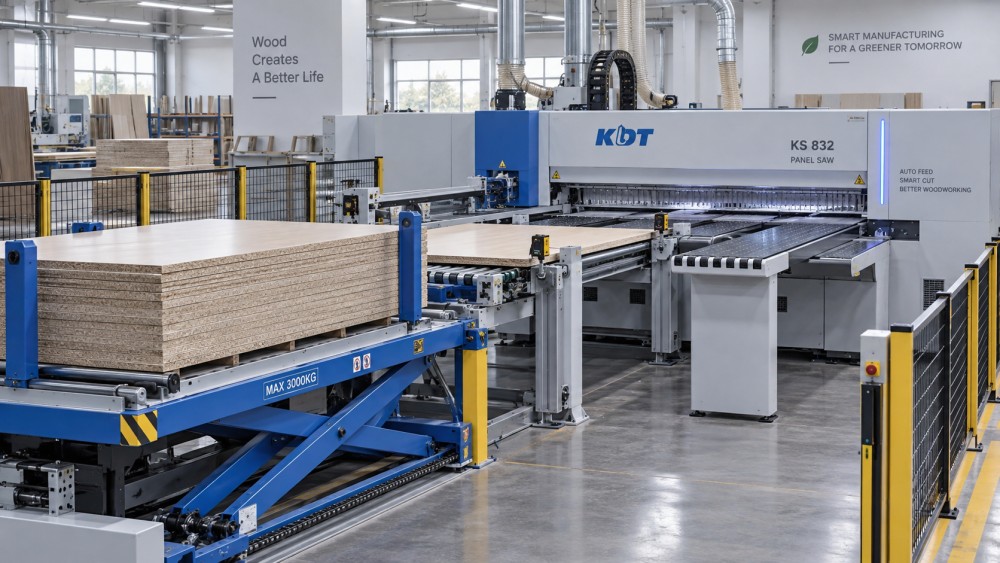
Rear-loading arrangements vary. Some use lifting platforms and powered transfer mechanisms; others incorporate additional storage or handling equipment. Diagnose the installed configuration rather than assuming that every rear-loading saw follows the same sequence.
For practical troubleshooting, divide panel supply into four handoffs: the required material reaches the loading area; the loading system presents it correctly; the transfer mechanism moves it toward the saw; and the saw confirms that it is ready for positioning and cutting. Observe these steps only from designated operating positions and outside safeguarded areas.
Record the first message before acknowledging it. Later messages may describe consequences of the original stop rather than its cause. Also note the material, job, stopping position, and whether the interruption occurred after replenishment, a material change, or a restart. These details help maintenance distinguish a repeatable fault from an isolated handling problem.
Keep diagnosis outside the danger zone
A stopped panel is not evidence that the handling system is safe to approach. Troubleshooting may involve lifting equipment, powered pushers, clamps, and stored energy. Operators should restrict initial checks to permitted observations and normal controls described in the machine instructions. Do not bypass guards or interlocks to test whether loading will resume.
When investigation requires entering a hazardous area, clearing a jam, or servicing equipment, follow the site’s applicable energy-control procedure and involve authorized personnel. An emergency stop is not a substitute for energy isolation. In US workplaces, OSHA 29 CFR 1910.147 addresses hazardous-energy control during servicing and maintenance, while 29 CFR 1910.212 covers general machine-guarding requirements. These references establish safety obligations, not a machine-specific fault-clearing procedure. Other jurisdictions require their own applicable rules.
Mechanical adjustments, sensor repositioning, and changes to loading logic belong with qualified personnel using the relevant documentation. The operator’s contribution is precise evidence: what happened, where it happened, and under which material conditions.
Check whether the right material is actually available
A stack near the machine may be unusable for the next cutting job. It could contain the wrong thickness, finish, dimensions, or material grade. Required panels might also be buried below another batch. Before treating an idle loader as a technical fault, compare the next job’s material specification with the accessible stack.
Check identification at the point of use, not only in the production schedule. A correct warehouse record does not establish that the correct stack has reached the rear-loading position. Mixed remnants, unreadable labels, and packaging that obscures identification can create uncertainty. Resolve that uncertainty before loading rather than relying on visual similarity between boards.
Then consider how the stack is presented. From a safe position, look for visibly displaced sheets, damaged corners, packaging left in the transfer path, or a stack that appears out of square. Whether any condition is unacceptable depends on the loading system and the manufacturer’s limits. Do not compensate for poor presentation by changing machine settings without establishing the cause.
If stoppages cluster around replenishment, examine the delivery routine. A stack placed inconsistently can create an intermittent problem that looks like equipment unreliability. The corrective action may be a clearer placement method, an agreed inspection point, or better communication between the forklift operator and saw operator.
Separate panel behavior from transfer faults
Where the installation separates individual panels or creates packs from a stack, material behavior becomes part of the diagnosis. Sheets may resist separation, arrive unevenly, or move differently after a material change. Possible contributors include panel distortion, surface friction, contamination, and stack condition. These are hypotheses to investigate, not reasons to increase force or alter limits immediately.
The comparison is especially useful when one material runs consistently and another does not. Record panel dimensions and thickness, visible bowing, surface type, and whether the affected stock was recently unpacked or moved from a different storage area. Avoid assigning the cause to moisture or static without supporting evidence.
During authorized inspection under the required safety procedure, maintenance can assess contact surfaces, guides, transfer components, and any separating mechanism fitted to the machine. Cleaning and adjustment methods must follow the equipment instructions; an unsuitable cleaner or lubricant could introduce a different handling problem.
If panels stop repeatedly at the same physical location, document that location. A consistent stopping point gives maintenance a focused area to examine. If the stopping point varies but interruptions follow one stack or material type, the stack and material conditions deserve closer attention. Neither pattern alone proves the cause.
Distinguish absent motion from absent permission
A loading mechanism may remain stationary because it has no command to move, not because its drive has failed. Depending on the installation, loading can require confirmation of stack position, available travel, guard status, receiving-area clearance, and completion of the previous sequence. The actual prerequisites must come from the machine’s operating and diagnostic documentation.
Use the normal operator display to identify the condition that remains incomplete. A useful maintenance report says, for example, that the loading sequence is waiting for a displayed confirmation despite apparently correct stack placement. “The loader is broken” provides much less direction.
Do not assume that a sensor is defective merely because its state seems inconsistent with what is visible. The object may be outside its intended detection position, or the controller may be waiting for a different sequence condition. Electrical testing and sensor adjustment require qualified personnel. Operator observations should preserve the distinction between what the screen reports and what can actually be seen.
Machine identity matters when consulting references. For a ZD330 installation, rear-loading ZD330 equipment details provides model-related context for discussing the rear-loading arrangement. It does not replace the installed machine’s operating manual, electrical drawings, or configuration records. Loading limits, fitted options, and diagnostic behavior should be confirmed against those documents rather than inferred from the model name.
Check whether the saw is waiting for discharge
An apparent supply interruption can originate downstream. If the receiving or cutting area has not completed its previous operation, the controller may withhold permission for another load. Depending on the layout, delayed part removal or an incomplete handling sequence can leave panels waiting at the rear without any defect in the loading equipment.
Observe the whole cycle from designated positions. Is the previous cut finished? Has the required discharge action occurred? Is the machine waiting for a normal operator confirmation? Distinguishing these conditions prevents unnecessary loader adjustments.
The production mix also affects the pattern. A job producing many small parts may require more sorting and handling than a job producing fewer large pieces. If loading pauses coincide with crowded outfeed areas, review removal and sorting arrangements. Supplying additional stacks will not resolve a restriction at discharge.
Plan replenishment around actual material demand
Panel supply planning should answer two questions: what material will be required next, and how early must replenishment begin? Planning only by the number of stacks consumed can hide delays caused by material changes, long retrieval routes, or stacks that need additional preparation.
Use the cutting schedule to identify upcoming material changes. Stage the next required material in an approved location without obstructing access or exceeding storage restrictions. A buffer is useful only when its contents match the upcoming work and can be delivered safely to the loader.
Base replenishment triggers on observed operating conditions. Measure the interval from requesting material to having it correctly positioned and ready. Compare that interval with the remaining usable material for the scheduled jobs. No universal buffer quantity suits every workshop: retrieval distance, handling availability, job sequence, and permitted storage space all affect the decision.
Make replenishment ownership explicit. If both the saw operator and material handler assume that someone else is monitoring stack depletion, interruptions can recur without any equipment fault. Define who requests the next stack, who checks its identity, and how readiness is communicated.
Verify the correction over comparable production
A successful restart is necessary, but it does not demonstrate that the recurring problem has been removed. Check the correction under the conditions that previously produced the interruption. If the fault followed a particular material, observe that material again. If it appeared after replenishment, include the next replenishment in the verification.
Keep the record simple enough to maintain during production:
- Job and material identification.
- Last completed supply handoff and first displayed message.
- Whether the delay began before loading, during transfer, or after arrival.
- Action taken and the person responsible.
- Whether the interruption returned under comparable conditions.
Avoid changing several settings at once. Doing so makes it difficult to identify which change helped and may conceal an unresolved mechanical or process issue. Adjustments should stay within authorized procedures, with maintenance involved where required.
The working goal is a predictable path from identified stock to an accepted load—not simply a loader that moves after a reset. When operators can identify the missing handoff, preserve the first fault evidence, and distinguish material availability from machine readiness, corrective work becomes more focused. Recurring supply interruptions then become specific problems to resolve rather than repeated pauses to work around.
Related News
- Automated Storage and Retrieval in Vietnam: Costs and Payback for WarehousesOct 28, 2026Automated storage retrieval Vietnam guide: compare installed costs, local support, and realistic payback to make a smarter warehouse investment. Explore key savings and risks.
- Port Handling Equipment Prices: Cost Ranges by Equipment Type and CapacityOct 23, 2026Compare port handling equipment price ranges by type and capacity, from reach stackers to STS cranes. Explore installed and lifecycle costs to plan your budget and buy smarter.
- Forklift Battery Swap Systems: Sizing Spare Batteries for Three-Shift OperationsOct 25, 2026Size your battery swap system for forklifts with confidence. Learn how to balance spare batteries, chargers, and peak demand to keep three-shift operations moving.
- Port Terminal Cargo Handling Equipment: Matching Machines to Cargo TypesOct 22, 2026Choose port terminal cargo handling equipment that fits your cargo. Explore machines for containers, bulk, and heavy loads to improve safety, reduce costs, and keep cargo moving.