
LMFP Export Price Jump Reshapes Forklift TCO
The timing of the underlying event is not clearly specified in the source input, but the latest signal is clear enough for the materials and equipment trade: a sharp week-on-week rise in China’s LMFP cathode export price is now feeding into lithium forklift quotations and changing how overseas buyers read replacement-cost assumptions inside three-year total cost of ownership models. For exporters, fleet buyers, supply-chain teams, and after-sales planners, the issue is not only a price move. It also reflects how trade-side constraints and upstream supply interruptions can quickly alter procurement terms, delivery planning, and budget discipline across industrial equipment purchases.
What the latest monitoring notice actually confirms
According to the June fourth-week export price monitoring bulletin released by the General Administration of Customs of China on 2026-06-29, the average export price of LMFP cathode material reached $28.6/kg on an FOB China basis. That level was 23.1% higher than in the third week of June.
The summary provided attributes the increase to two confirmed factors: tighter cobalt ore export quotas in the Democratic Republic of the Congo and concentrated maintenance shutdowns at domestic electrolytic cobalt smelters.
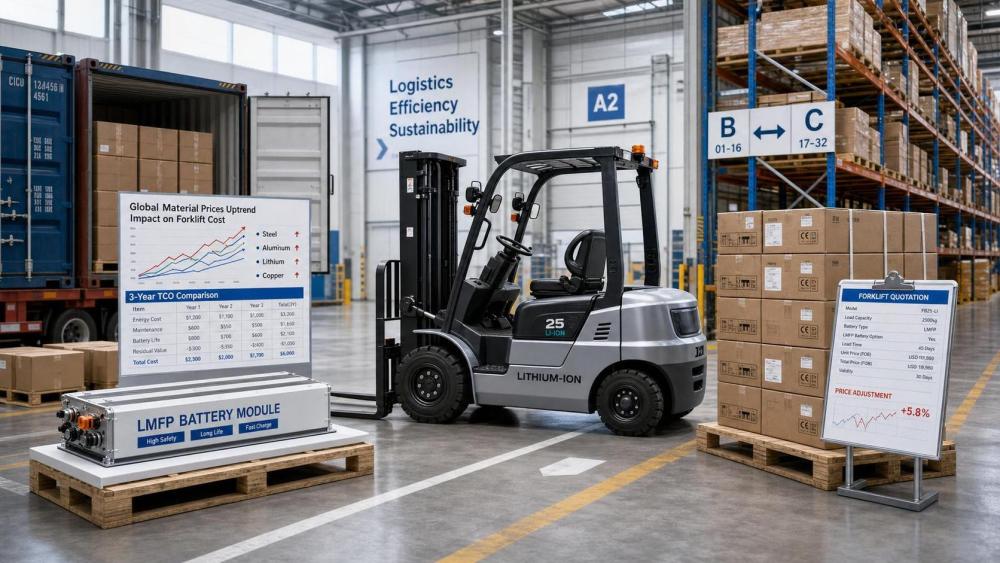
The same summary states that the price increase has already been transmitted into quotations from mainstream lithium forklift manufacturers. It further states that, in overseas customers’ three-year TCO models, the battery replacement cost item has been revised upward by an average of 11.4%, with a notable effect on equipment renewal budgets for European warehouse operators and Southeast Asian e-commerce distribution centers.
Where the operational pressure is likely to appear first
Export quotations are becoming harder to hold constant
From an industry perspective, lithium forklift exporters are likely to feel the impact first in quotation validity, price adjustment clauses, and customer negotiations around battery-related cost assumptions. When cathode export prices move sharply within a week and that movement is already reflected in forklift offers, exporters need to pay closer attention to contract language, quotation periods, and any supporting trade documents tied to pricing terms and delivery commitments.
Fleet buyers face a narrower margin in budget planning
For overseas procurement teams and equipment operators, the most immediate pressure point is budget control. The summary already links the LMFP price rise to an average 11.4% upward revision in the battery replacement portion of three-year TCO models. Observably, this does not automatically mean orders stop, but it does mean buyers may need to recheck procurement
Related News
- How to Select Container Terminal Equipment for Throughput, Yard Layout, and TCOSep 13, 2026Container Terminal Equipment selection guide: match throughput, yard layout, energy options, automation, and total cost of ownership for smarter terminal investment.
- How to Select Warehouse Lift Tables for Load Capacity, Travel Height, and Duty CycleSep 10, 2026Lift tables warehouse selection guide: match load capacity, travel height, duty cycle, safety, and workflow needs for reliable material handling.
- Is predictive maintenance financially justified for small warehouses with under 50,000 sq ft?Sep 13, 2026What height should a lift table be set for ergonomic packing stations? Discover how optimizing this—before investing in predictive maintenance—boosts ROI in small warehouses.
- Yard Productivity Optimization: How to Reduce Truck Turnaround Time and Gate CongestionSep 04, 2026Yard productivity optimization strategies to cut truck turnaround time, ease gate congestion, synchronize docks, and improve yard flow with actionable insights.