
Warehouse Throughput Metrics Explained: Which KPIs Actually Predict Bottlenecks?
Why do warehouse throughput metrics matter beyond simple output counts?
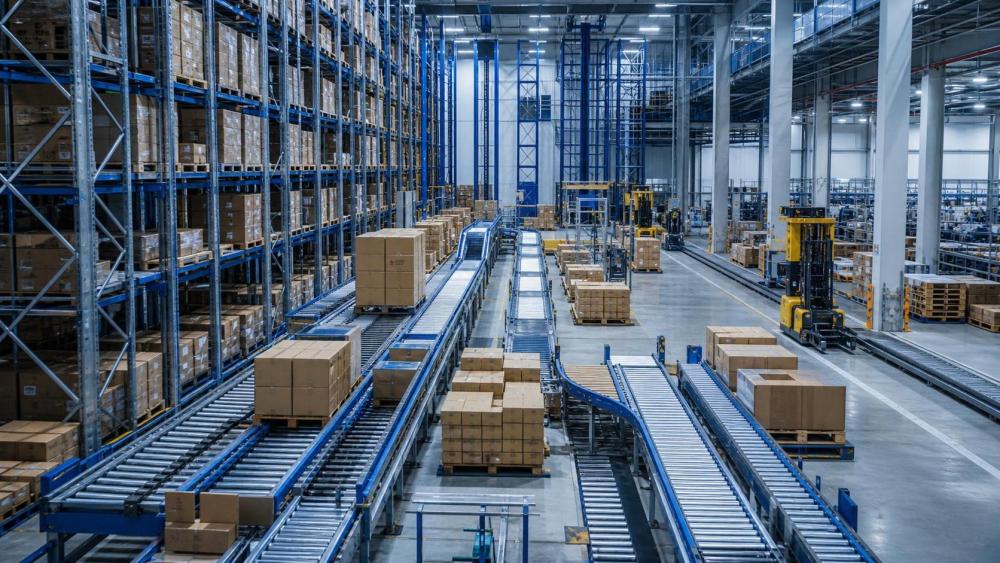
Warehouse throughput metrics are often treated as scorekeeping tools. That is too narrow. The better use is diagnosis.
A warehouse can ship more orders this week and still be moving toward congestion. Output alone rarely shows where capacity is quietly disappearing.
That is why warehouse throughput metrics matter in facilities using forklifts, conveyors, sorters, AS/RS, shuttle systems, or mixed manual workflows.
In practical terms, the real question is not, “How many units moved?” It is, “What signal changes before queues, misses, and delays become visible?”
For operations covered by MHLS, that distinction matters. A high-bay automated warehouse and a forklift-led distribution center face different bottlenecks, but both leave clues in the data.
Good warehouse throughput metrics connect output with travel time, dwell time, slot access, labor balance, system availability, and order profile complexity.
When these signals are read together, they help separate short-term productivity spikes from sustainable throughput capacity.
Which warehouse throughput metrics actually predict bottlenecks?
The most useful warehouse throughput metrics are usually leading indicators, not end-of-shift summaries. They show strain before service levels collapse.
Several metrics deserve consistent attention across manual, semi-automated, and highly automated sites.
- Order cycle time by process step, not only overall average.
- Queue length and queue duration at receiving, picking, packing, sortation, and shipping.
- Touches per order line or per pallet move.
- Travel time versus handling time for forklifts or mobile robots.
- Slot replenishment delay and reserve-to-pick response time.
- Equipment utilization with blockage frequency, not utilization alone.
Take equipment utilization as an example. High utilization may look efficient, yet it often means there is no recovery buffer.
A conveyor running at 92% utilization during peaks can be more fragile than one at 75%, especially when carton profiles vary.
The same applies to forklifts. If travel time rises while picks per labor hour stay flat, aisle interference may already be reducing true capacity.
In AS/RS environments, blocked retrievals, crane wait states, and bin access conflicts usually reveal more than gross lines shipped.
The table below summarizes which warehouse throughput metrics are worth watching and what they often reveal.
Are output per hour and utilization enough to judge warehouse performance?
Usually not. These are useful, but they are incomplete and often misleading when used alone.
Output per hour is sensitive to order mix. A shift with fewer, larger orders may look stronger than one handling smaller, multi-line orders.
Utilization has the same problem. A sorter, reach truck fleet, or shuttle system can appear productive simply because it is always busy.
Busy equipment is not the same as balanced flow. In fact, constant busyness often means downstream release logic is poor or upstream buffering is excessive.
A more reliable approach is to read warehouse throughput metrics in combinations. That makes bottleneck prediction far more accurate.
- Pair output with queue duration to see whether volume is sustainable.
- Pair utilization with blockage events to expose hidden control or layout problems.
- Pair labor productivity with replenishment latency to avoid blaming the wrong process.
- Pair dock turns with staging dwell time to detect outbound compression.
This is especially important when comparing system options. A manual pick module, AMR deployment, and AS/RS installation may all reach similar hourly output, but under very different stress conditions.
The better evaluation question is whether the warehouse throughput metrics remain stable as SKU count, order fragmentation, and peak profiles change.
How do these metrics change across forklifts, conveyors, sorters, and AS/RS?
The same KPI names can mean different things in different material handling environments. Context matters more than a generic dashboard.
In forklift-driven operations, warehouse throughput metrics often point first to travel inefficiency, battery interruptions, aisle conflict, or poor replenishment timing.
For conveyor and sorter systems, the early warning signs usually involve merge pressure, recirculation, induction imbalance, or carton presentation errors.
In crane or hoist-supported heavy handling zones, throughput losses can come from sequencing delays, safety clearance rules, and handoff timing between stations.
AS/RS and shuttle systems require another layer. There, warehouse throughput metrics should include software decision timing, storage policy, and exception recovery speed.
That is one reason industry analysis platforms such as MHLS are useful. Throughput should never be interpreted without the mechanics and control architecture behind it.
A site using lithium-ion forklifts, machine vision, WCS software, and high-density storage will produce a very different bottleneck pattern from a conventional pallet warehouse.
So the right method is not copying another facility’s KPI list. It is mapping each metric to how goods physically move through that specific system.
A practical way to compare different warehouse designs
When reviewing alternatives, compare metrics at three levels: flow, asset strain, and recovery.
- Flow: lines per hour, cycle time spread, queue duration, dock release timing.
- Asset strain: utilization, blocked moves, battery or charging interruption, recirculation rates.
- Recovery: restart time after exception, replenishment catch-up speed, backlog clearance after peaks.
That comparison reveals whether a system performs only in clean conditions or can absorb real operating variability.
What mistakes make warehouse throughput metrics less useful?
The most common mistake is chasing a single number. Warehouses fail in chains, not in isolated moments.
Another mistake is relying on averages. Average pick rate, average cycle time, and average utilization can hide the exact period when bottlenecks form.
It is usually better to inspect percentiles, peak windows, and exception clusters. Congestion rarely arrives evenly.
Data separation is another problem. Labor data may sit in one system, equipment status in another, and WMS events in a third.
If those sources are not aligned by time and process step, warehouse throughput metrics become descriptive instead of predictive.
There is also a design mistake: measuring output without understanding slotting logic or product characteristics.
Fast-moving cartons, long loads, fragile goods, and palletized bulk do not create the same friction pattern. KPI interpretation must respect that reality.
Finally, some teams overlook safety and compliance constraints. Travel speed, crane swing control, forklift routing, and dock discipline can cap throughput for good reasons.
A metric should support better decisions, not encourage shortcuts that increase risk.
How should you build a useful KPI set before comparing systems or upgrades?
Start with the bottleneck question, not the dashboard question. Ask where flow stalls, what triggers it, and how quickly the operation recovers.
Then choose warehouse throughput metrics that match the physical process. A dock-heavy facility needs different emphasis than a goods-to-person system.
In most cases, a compact KPI set works better than a long one. Focus on metrics that are actionable, comparable, and time-aligned.
- Define one unit of flow, such as lines, cartons, pallets, or completed orders.
- Track the same flow through receiving, storage, picking, packing, and shipping.
- Add one leading metric for delay, one for asset strain, and one for recovery.
- Review peaks separately from daily averages.
- Test whether the KPI changes when order mix or SKU velocity changes.
That approach produces warehouse throughput metrics that are useful for layout review, automation selection, labor planning, and TCO analysis.
It also helps frame discussions around conveyors, sorters, forklifts, cranes, robotics, WCS logic, and storage density in one consistent way.
A sensible next step is to map current bottleneck points, collect timed process data by zone, and compare those findings against future-state assumptions.
When warehouse throughput metrics are chosen carefully, they do more than report performance. They explain where capacity is won, where it is lost, and what change is worth testing next.
Related News
- How to Select Container Terminal Equipment for Throughput, Yard Layout, and TCOSep 13, 2026Container Terminal Equipment selection guide: match throughput, yard layout, energy options, automation, and total cost of ownership for smarter terminal investment.
- How to Select Warehouse Lift Tables for Load Capacity, Travel Height, and Duty CycleSep 10, 2026Lift tables warehouse selection guide: match load capacity, travel height, duty cycle, safety, and workflow needs for reliable material handling.
- Is predictive maintenance financially justified for small warehouses with under 50,000 sq ft?Sep 13, 2026What height should a lift table be set for ergonomic packing stations? Discover how optimizing this—before investing in predictive maintenance—boosts ROI in small warehouses.
- Yard Productivity Optimization: How to Reduce Truck Turnaround Time and Gate CongestionSep 04, 2026Yard productivity optimization strategies to cut truck turnaround time, ease gate congestion, synchronize docks, and improve yard flow with actionable insights.