
EU ATEX Rule Mandates Digital e-Certificates
On July 21, 2026, a new compliance requirement for ATEX-related equipment entering the EU market took effect after the Official Journal of the European Union published revised implementation guidance for Directive 2014/34/EU on July 20. The update draws immediate attention from exporters of explosion-proof forklifts, AGV tow tractors, stacking cranes, and explosion-proof conveyor systems, as well as importers and warehouse operators that rely on WCS and PLC verification workflows. For the industry, the issue is not only product certification itself, but also how compliance records now need to be machine-readable and available for real-time checks during cross-border and inbound processes.
What the new requirement formally covers
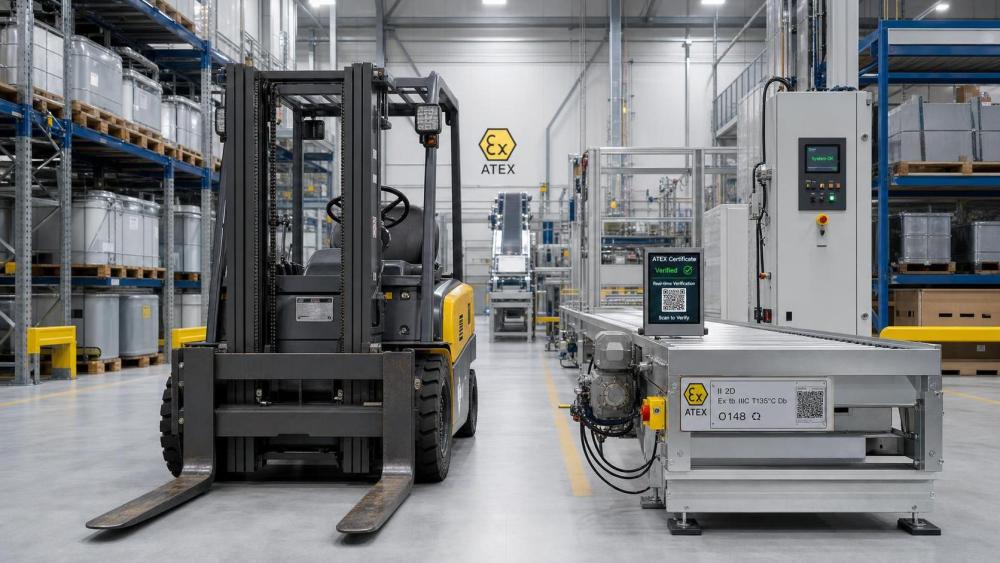
According to the provided information, the revised implementation guidance under the ATEX Directive (2014/34/EU) was published in the OJEU on July 20, 2026. It clarifies that from July 21, 2026, all newly placed explosion-proof forklifts, AGV tow tractors, stacking cranes, and explosion-proof conveyor systems entering the EU market must be accompanied by a machine-readable e-Certificate. The e-Certificate is described as being based on ETSI EN 303 645 and must be integrated into WCS or PLC systems so that customs authorities and importers can verify compliance in real time.
Where the pressure is likely to appear first
Export manufacturers face a changed certification path
From an industry perspective, manufacturers shipping covered equipment into the EU are likely to feel the impact first because the requirement directly changes how compliance documentation is prepared and delivered. The immediate pressure point is the certification path itself: product approval is no longer only about having supporting documents, but about ensuring those documents are machine-readable and usable within downstream verification systems.
Importers and distributors must align inbound checks
Importers and overseas distribution channels are also likely to see process changes because the requirement is tied to real-time verification by customs and import-side stakeholders. In practical terms, inbound compliance review, goods receiving, and internal release procedures may need to reflect whether the e-Certificate can be read and verified through the relevant WCS or PLC-linked process.
System-linked logistics operations come into focus
For warehousing and handling environments using WCS or PLC architecture, the update matters because compliance data is no longer separate from operational systems. Analysis shows that this creates a closer connection between product documentation, customs verification, and equipment intake workflows, especially for facilities handling explosion-proof material handling and conveying equipment.
What companies should watch now
Check whether covered products fall within the immediate scope
What deserves closer attention is product scope. Companies dealing in explosion-proof forklifts, AGV tow tractors, stacking cranes, and explosion-proof conveyor systems should review whether newly placed EU-market units from July 21, 2026 are prepared with the required e-Certificate format and associated system integration expectations.
Separate document possession from system readiness
Observably, the policy signal is not limited to having a certificate on file. The provided summary points to real-time verification through WCS or PLC systems, which means businesses should distinguish between holding a compliance document and being operationally ready for customs and importer-side validation.
Reassess delivery timing and customer communication
The supplied information explicitly notes potential effects on certification routes, delivery schedules, and distributor inbound compliance procedures for Chinese exporters. Based on that, exporters and channel partners should pay close attention to order scheduling, handover documentation, and customer communication around acceptance conditions for EU-bound shipments.
Keep watching for further official clarification
Because the requirement has been described through revised implementation guidance, companies should continue to monitor whether additional official wording, procedural clarification, or related compliance interpretation affects how the rule is applied in actual cross-border transactions and intake processes.
Why this reads as more than a paperwork update
Analysis shows that this development is better understood as an operational compliance change rather than a narrow documentation revision. The core shift in the provided information is the move from static certification support toward machine-readable, system-connected verification. That matters because it can influence not just regulatory review, but also the sequencing of export preparation, import clearance, and distributor receiving procedures.
It is more appropriate to understand this as an immediate rule change with longer-term signaling value. The immediate part is clear from the stated effective date of July 21, 2026. The longer-term signal is that compliance expectations for covered industrial equipment may increasingly be tied to digital verification capability, which is why the industry will need to keep watching how implementation unfolds.
How to read the development at this stage
At this stage, the most balanced reading is that the new EU ATEX-related requirement has already created a concrete compliance threshold for newly placed covered equipment, while some practical implications still depend on how businesses and verification counterparties apply it in real operations. For manufacturers, importers, and distributors, the issue is not abstract policy change but whether certification, system integration, and delivery coordination remain aligned under the new requirement.
Basis of this article and follow-up verification
This article is based on the user-provided news title, event date, and event summary concerning the revised ATEX implementation guidance published in the OJEU and its July 21, 2026 effective date. Information of this kind is commonly cross-checked against official notices, company disclosures, industry association updates, authoritative media reporting, and standard-setting documents. The specific official source link was not provided in the input, so continued verification remains necessary. Follow-up attention should focus on any further official clarification on certificate format, system integration expectations, and how customs, importers, and distributors implement real-time verification in practice.
Related News
- Evaluating Quality Control Protocols for Marine Dredging Equipment Sourced from China-Based ManufacturersSep 11, 2026dredging equipment manufacturer: Discover how to verify real-world QC protocols—not just certifications—for reliable marine dredging gear from China.
- Warehouse Safety Compliance Audit Checklist: What to Inspect Before an OSHA VisitSep 08, 2026Warehouse safety compliance audit checklist for OSHA readiness. Inspect forklifts, racks, charging zones, automation, docks, exits, and corrective actions.
- How Much Does CE ATEX Compliance Cost for Industrial Equipment? Key Cost DriversSep 05, 2026CE ATEX Compliance cost explained: discover the key cost drivers for industrial equipment, from hazardous-area design to certification, documentation, and installation planning.
- Forklift Safety Standards for Cold Storage: OSHA Rules and Risk ControlsSep 02, 2026Forklift Safety Standards cold storage: explore OSHA rules, freezer-specific risk controls, inspections, battery safety, and traffic management strategies.