
How warehouse fleet monitoring prevents avoidable vehicle downtime
A forklift that stops in the middle of a receiving shift rarely fails “without warning.” In many cases, the warning was already present: a rising motor temperature, a battery that no longer holds its expected charge, repeated impact events in one aisle, an overdue inspection, or a fault code that was cleared without being investigated. The real problem is that these signals are often scattered across operator reports, service tickets, paper checklists, and the memories of busy technicians.
Warehouse fleet monitoring brings those fragments together. For after-sales maintenance teams, it is not simply a dashboard showing where vehicles are located. Used well, it becomes an early-warning and planning tool for forklifts, reach trucks, order pickers, tow tractors, and other material-handling vehicles. It helps teams see which assets are working hard, which faults are becoming repetitive, which batteries need attention, and which service actions should be scheduled before a vehicle becomes unavailable during a critical shift.
The goal is not to eliminate every breakdown. Warehouses are demanding environments, and equipment will still wear. The practical goal is to prevent the failures that could have been anticipated, reduce the length of unavoidable repairs, and make maintenance decisions based on operating evidence rather than guesswork.
Downtime usually begins long before the vehicle is parked
Maintenance teams are often called only when an operator can no longer use a truck. By then, a small issue may have developed into a lost shift, an urgent parts request, a safety review, and pressure from operations to return the unit immediately. Reactive work is unavoidable at times, but a fleet that is managed only through breakdown calls will consume technician capacity without addressing its underlying causes.
Consider a lithium-ion electric forklift working through multiple shifts. A technician may receive a report that the truck has reduced performance near the end of the day. Without connected data, the cause could be interpreted as a battery problem, a charging issue, excessive load demand, an overheating drive system, or even an operator practice issue. Fleet monitoring can provide the context: charge cycles, battery temperature trends, state-of-charge behavior, travel time, lift activity, alarms, and charging duration. The technician still has to diagnose the equipment, but starts with a much narrower and more useful set of questions.
The same principle applies to internal combustion forklifts, container handlers, and yard tractors. Engine hours, coolant or oil alerts, regeneration-related events, idle patterns, hydraulic warnings, and recurring operator-reported defects can reveal deterioration before it results in a roadside-style recovery inside the warehouse or yard.
What a maintenance team should monitor—not just collect
More data does not automatically produce less downtime. The useful starting point is to identify signals that change a maintenance decision. A warehouse fleet monitoring program should focus on information that helps the team inspect, schedule, dispatch, repair, or escalate at the right time.
Fault codes with operating context
Diagnostic trouble codes are valuable, but a code alone may not tell the whole story. A fault that occurs once during startup is different from the same fault appearing repeatedly after long travel periods, during high-lift operation, or following a battery change. Maintenance software should retain fault history, time stamps, vehicle hours, and, where available, the operating conditions surrounding the event.
Repeated low-severity faults deserve attention. Clearing them may restore the truck temporarily, but recurring alarms often point to loose connections, deteriorating sensors, cooling limitations, charging irregularities, or component wear. Trend review lets technicians intervene while the vehicle can still be removed from service on their terms.
Utilization, duty cycle, and workload imbalance
Hour-meter-based service plans remain important, yet two trucks with similar operating hours may experience very different stress. One may spend much of its time traveling unloaded on smooth floors; another may repeatedly lift near-capacity pallets in a cold store, work on ramps, or handle uneven loads at the dock.
Usage data helps maintenance managers understand this difference. Travel hours, lift cycles, load-related activity where supported, idle time, and shift distribution can show whether a small group of vehicles is carrying disproportionate work. That insight can guide fleet rotation and preventive maintenance timing. It also prevents a common mistake: assuming that a truck with lower calendar age or fewer total hours is automatically the lower-risk asset.
Battery, charging, and energy events
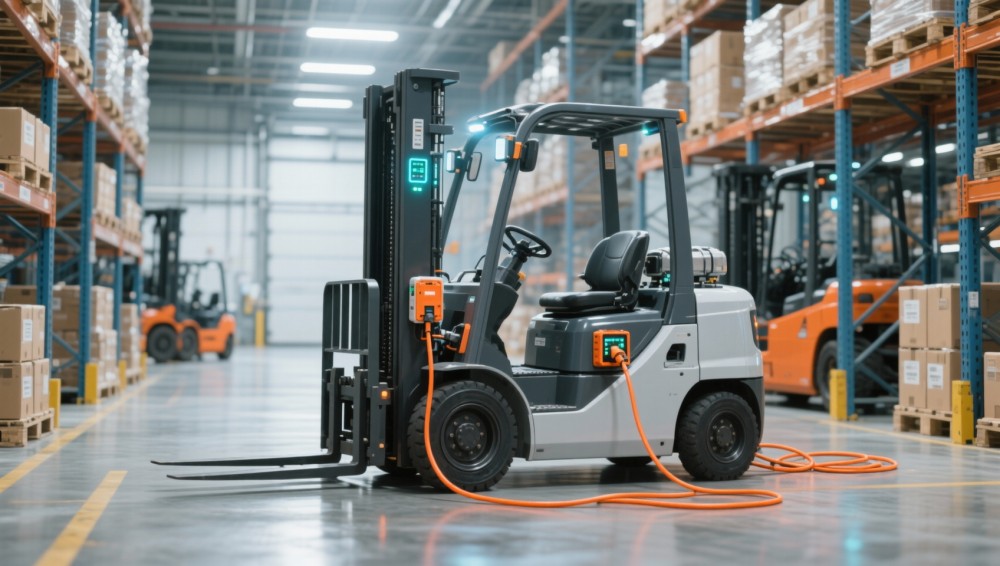
For electric fleets, energy health is one of the clearest links between fleet monitoring and vehicle availability. The maintenance team should be able to review state of charge, charge acceptance, charging duration, battery temperature alerts, abnormal discharge patterns, and missed charging opportunities. With lead-acid batteries, watering practices, equalization cycles, connector condition, and battery swap records may also be relevant. With lithium-ion systems, thermal events, charger compatibility, and battery management system alerts require close coordination between the vehicle supplier, battery provider, and site team.
A vehicle that returns with insufficient usable charge may be described as “out of service,” even if no mechanical component has failed. Monitoring helps distinguish between an equipment defect and an operational charging problem. That distinction matters: replacing a part will not solve a queue at the chargers, poor opportunity-charging habits, or a charger that intermittently drops communication.
Impact events and operator safety signals
Impacts are not only safety events. They can create hidden damage that later becomes downtime: cracked brackets, bent forks, steering misalignment, loosened battery restraints, damaged mast components, or stressed electrical connections. A telematics alert should trigger a proportionate process rather than an automatic assumption of misuse.
For example, a low-threshold event may warrant a supervisor conversation and visual check. A high-energy event, repeated events on the same truck, or an impact followed by a fault code may require the vehicle to be inspected before returning to service. Linking impact data with location, shift, operator authorization, and equipment condition helps maintenance and safety teams investigate fairly and consistently.
Turn alerts into a maintenance workflow
The difference between an informative monitoring platform and an effective one is workflow. If alerts merely accumulate in an inbox, technicians will soon ignore them. Maintenance leaders should define what happens after each priority category is triggered.
These rules should reflect the manufacturer’s service recommendations, local safety procedures, and the application. A reach truck operating in a high-bay aisle has different availability and safety consequences from a pedestrian pallet truck used intermittently in a packing area. There is no benefit in applying the same alert threshold to every asset simply because the software makes it easy.
Plan work around the operation instead of fighting it
After-sales teams often face the same frustration: operations says every truck is needed, while maintenance knows that delaying service will make the eventual interruption longer. Fleet visibility gives both sides a shared basis for planning.
A maintenance coordinator can identify vehicles with lower utilization during particular shifts, group work by location, and prepare common parts before taking equipment offline. If one truck shows an emerging issue but has a suitable backup available, it can be scheduled for inspection before peak order waves. If several vehicles are nearing service intervals, the team can avoid pulling them all at once and protect the minimum fleet availability required for receiving, replenishment, and dispatch.
This is particularly important in e-commerce fulfillment centers and multi-shift distribution operations, where a small number of unavailable reach trucks can quickly constrain replenishment. It also matters in manufacturing plants, where one forklift supporting a production cell may be more operationally critical than several higher-hour vehicles elsewhere in the facility. Monitoring data should therefore be paired with an asset criticality rating, not viewed in isolation.
Create a practical criticality map
For each vehicle, record more than model and serial number. Note the process it supports, compatible backup equipment, attachment requirements, battery or fuel type, aisle or dock constraints, and whether trained operators are available for substitute units. A specialized clamp truck, cold-store-rated forklift, or narrow-aisle machine may have no easy replacement. Those assets deserve tighter alert review and more conservative service planning.
Criticality also helps prioritize repairs when parts are delayed. Instead of repairing the loudest complaint first, the team can decide which return-to-service action best protects throughput and safety.
Use monitoring to improve diagnosis, not replace technicians
Connected fleet systems can reduce diagnostic time, but they do not eliminate the need for skilled maintenance judgment. A fault code may indicate a circuit issue; it does not always identify whether the root cause is wiring damage, moisture ingress, a failed component, a charging event, or an external operating condition. Likewise, a low-utilization report may reflect a vehicle fault—or it may mean operators avoid that truck because of handling behavior that has never been documented.
The strongest process combines remote evidence with field inspection. Technicians should be able to compare telematics data against operator pre-use checklists, work-order history, parts consumption, warranty records, and physical inspection results. When the same failure mode is observed across multiple vehicles, the team can investigate whether there is a site condition behind it: rough floor transitions, poor charging infrastructure, unsuitable attachments, inadequate cleaning, or a training gap.
Over time, this turns maintenance records into a feedback loop. A service manager can see not only that a component was replaced, but whether the replacement ended a recurring event pattern. That is much more valuable than closing a work order simply because the truck restarted.
Common mistakes that keep downtime “avoidable”
Treating telematics as a management-only tool. If maintenance personnel cannot easily access relevant alerts and vehicle history, useful information remains trapped in reports prepared for someone else. Technicians need concise, actionable views—not a wall of charts.
Using generic preventive maintenance intervals without usage review. Calendar and hour-based schedules are necessary foundations, but intensive applications may need earlier inspection of specific wear points. Conversely, a lightly used vehicle should not be taken out of service unnecessarily when evidence supports a different planning decision.
Closing alerts without documenting the finding. “Checked OK” is rarely enough for recurring issues. Record what was inspected, what was measured, whether a part was changed, and what follow-up is needed. This protects continuity between shifts and makes trend analysis possible.
Ignoring data quality. Incorrect asset naming, missing serial numbers, inactive vehicles left in reports, inconsistent shift assignments, or untrained operators can undermine confidence in the whole system. Assign ownership for data governance just as clearly as ownership for repairs.
Monitoring only the truck. Availability depends on the wider ecosystem: chargers, battery rooms, fuel infrastructure, Wi-Fi coverage, warehouse management processes, operator access controls, and spare parts availability. A vehicle may be mechanically sound but unavailable because one of these supporting systems has failed.
Choosing a warehouse fleet monitoring setup that supports service work
When evaluating a monitoring platform or connected-fleet service, maintenance teams should look beyond map views and headline utilization reports. Ask whether the system can integrate with existing maintenance management software, import or export work-order data, maintain clear vehicle histories, and distinguish between warning-level and safety-critical events. Check whether fault information is understandable for the specific vehicle brands in the fleet and whether access permissions allow technicians, supervisors, rental partners, and OEM service providers to see the information they need.
Multi-brand fleets require particular care. A portal that works well for one manufacturer may offer limited diagnostic depth for another. The right solution may involve OEM telematics for detailed vehicle health combined with a fleet-level layer for utilization, service planning, and standardized reporting. The objective is not to force every asset into identical data fields; it is to create enough consistency for sound maintenance decisions.
Data ownership and cybersecurity also deserve attention. Establish who can access operator and vehicle information, how long event data is retained, how remote connectivity is secured, and how the site will respond if communications are interrupted. These are operational questions, not just IT questions.
From emergency repairs to controlled availability
Warehouse fleet monitoring is most valuable when it changes the daily rhythm of maintenance. Instead of beginning the shift with a list of failed vehicles, the team can begin with a prioritized review: Which trucks have emerging faults? Which battery events need verification? What service can be completed during the next low-demand window? Which critical assets need parts staged now?
That shift does not make warehouse work predictable in every detail. Peak volumes, accidental damage, and component failures will still happen. But it gives after-sales maintenance teams a better chance to catch weak signals early, protect critical equipment, and explain their decisions with evidence. In an operation where every pallet movement depends on equipment availability, that is how preventable downtime becomes far less routine.
Related News
- How warehouse fleet monitoring prevents avoidable vehicle downtimeSep 29, 2026Warehouse fleet monitoring helps prevent avoidable vehicle downtime with early fault detection, battery insights, impact alerts, and smarter maintenance decisions.
- When warehouse automation for mid market operations reaches paybackSep 26, 2026Warehouse automation for mid market operations: learn how to calculate true payback, remove bottlenecks, control total costs, and build a scalable investment case.
- Pre-Dispatch Inspection Points That Reduce Skeletal Chassis DowntimeSep 24, 2026Skeletal container chassis pre-dispatch inspection points: check twist locks, brakes, tyres, frame, and coupling to prevent downtime, delays, and costly roadside failures.
- How to Select Container Terminal Equipment for Throughput, Yard Layout, and TCOSep 13, 2026Container Terminal Equipment selection guide: match throughput, yard layout, energy options, automation, and total cost of ownership for smarter terminal investment.