
What MHLS means in modern material handling operations
What MHLS Means in Modern Material Handling Operations
MHLS, or Material Handling and Logistics Systems, is best understood as the operating environment that keeps physical goods moving through industrial facilities. It is not limited to one machine category, one warehouse technology, or one logistics process. In a modern setting, MHLS brings together forklifts, cranes, hoists, conveyors, storage systems, sorting equipment, robotics, warehouse software, energy infrastructure, and safety controls.
That broad definition matters because material movement is rarely an isolated task. A pallet lifted by an electric counterbalance forklift may later enter a conveyor line, pass through barcode verification, be stored in an automated storage and retrieval system, then be dispatched through a dock managed by warehouse control software. If any handoff is poorly designed, the operation may still have capable equipment but unreliable flow.
For researchers, operators, procurement teams, and equipment suppliers, MHLS is therefore a useful lens for examining how industrial organizations handle throughput, storage density, load safety, labor constraints, maintenance exposure, and total cost of ownership. It covers warehouses and fulfillment centers, but also factories, steel yards, ports, container terminals, cold-storage sites, and production lines where goods or heavy loads need to be positioned accurately.
MHLS Is a Connected System, Not a List of Machines
A common mistake is to view material handling as a purchasing exercise: choose a forklift, add racks, install a conveyor, and the project is complete. In practice, equipment selection is only one part of the system. The more important question is whether the equipment, layout, software logic, people, and operating rules work together under normal and peak conditions.
Consider a distribution center with fast-moving e-commerce orders. A high-speed sorter can be technically impressive, yet its benefit is limited if inbound parcels arrive without reliable identification, induction stations are poorly balanced, or the warehouse management system cannot release work in the right sequence. The same principle applies to a high-bay AS/RS installation. Storage density may increase, but the real operational result depends on order profiles, replenishment logic, machine availability, fire protection requirements, aisle access, and how exceptions are handled.
MHLS looks at these dependencies. It asks not only, “What can this equipment do?” but also, “What happens before it, after it, and when something goes wrong?” That is the difference between a catalogue-level conversation and an operational one.
The Physical Layer: Lifting, Transport, Storage, and Sorting
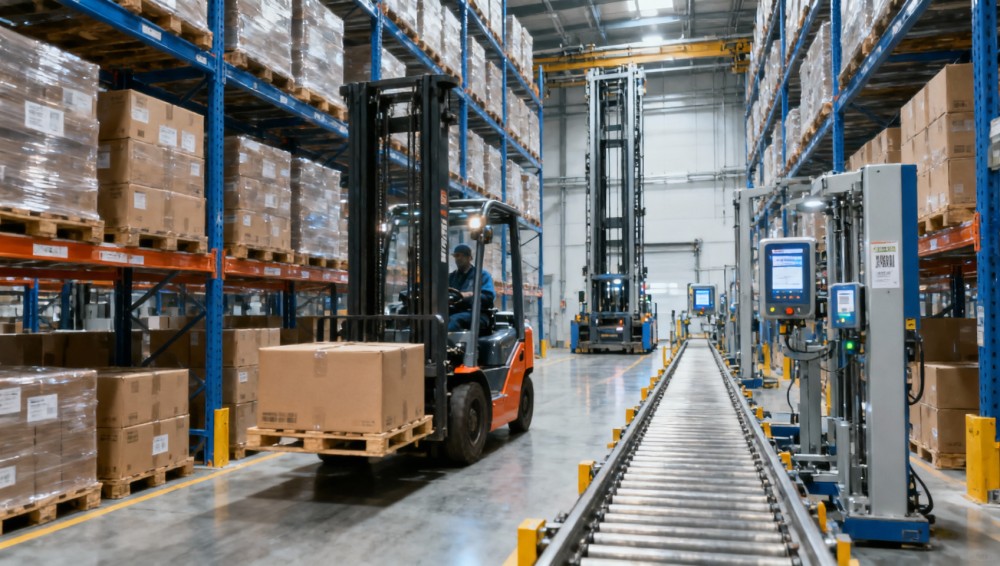
The physical side of MHLS includes the machinery people can see and operate. Industrial forklifts remain central because they provide flexible movement between receiving, storage, production, staging, and loading areas. Electric forklifts are increasingly evaluated for indoor air quality, lower local emissions, noise reduction, and charging strategy. Lithium-ion battery systems can simplify opportunity charging in some duty cycles, but they also require disciplined assessment of charger capacity, electrical infrastructure, battery service support, and operating temperature.
Heavy-duty counterbalance forklifts, reach trucks, and specialized attachments address different load geometries and aisle conditions. The rated capacity shown on a truck is not a universal permission to lift every load of that weight. Load center, mast height, attachment weight, tire selection, floor condition, and load stability can all alter the safe operating envelope. This is why forklift selection should begin with actual load data rather than a broad statement such as “we usually handle two-ton pallets.”
For larger or suspended loads, bridge cranes and electric hoists form another major part of the MHLS landscape. In a fabrication shop or manufacturing plant, the challenge is often not simply lifting capacity. Operators may need controlled positioning, repeatable travel paths, low swing, and safe coordination with people working below or near the load. Variable frequency drive control and anti-sway functions can support smoother handling, but they do not replace correct rigging, operator training, inspection routines, or an understanding of the load’s center of gravity.
Conveyors and sortation systems are usually introduced when movement becomes repetitive enough that manual transport creates delay, inconsistency, or ergonomic strain. Belt conveyors, roller conveyors, cross-belt sorters, and shoe sorters all have different strengths. The right choice depends on item size, weight distribution, package condition, required divert rate, accumulation needs, and how much variation the operation must absorb. A system optimized for uniform cartons may struggle with polybags, unstable parcels, or irregular products unless the induction and sensing design account for them.
Automation Changes the Decision Criteria
Automation is often discussed as though it automatically means fewer people and faster operations. That is too simplistic. In material handling, automation is mainly a way to make selected tasks more repeatable, traceable, and predictable. Automated guided vehicles, autonomous mobile robots, shuttle systems, stacker cranes, robotic palletizing cells, and AS/RS equipment can reduce unnecessary travel and stabilize routine movement. Their value is strongest where process variation is understood and physical conditions are controlled.
An AS/RS may be appropriate when building height is available, pallet profiles are relatively consistent, storage density is a priority, and inventory discipline is already mature. It may be a poor fit when products change frequently, pallet quality is inconsistent, or the facility lacks a practical plan for downtime and manual recovery. Automation does not eliminate exceptions; it makes exception management more visible.
Warehouse control systems, often called WCS platforms, sit between operational software and automated equipment. They can coordinate work release, route cartons, allocate tasks, manage conveyor zones, and communicate with subsystems. Their importance is easy to underestimate. A warehouse can have competent machines from reputable suppliers and still underperform if the control logic cannot manage congestion, priority orders, blocked lanes, or a machine temporarily taken out of service.
In other words, modern MHLS increasingly combines mechanical engineering with software behavior. Layout drawings and equipment specifications remain necessary, but they are no longer enough to explain how an operation will perform during a busy shift.
Data Quality Has Become a Material Handling Issue
Barcode scanning, QR identification, RFID in selected applications, machine vision, weight checks, and dimensioning systems all support the digital visibility of goods. These technologies are sometimes treated as add-ons, yet they directly affect physical flow. If a carton cannot be identified at induction, it may require manual handling. If a pallet label is unreadable at a storage aisle, inventory accuracy and put-away speed are affected. If dimensions are incorrect, automated routing or storage allocation may fail.
The useful question is not whether a facility needs “more data.” It is whether the data is captured at the moment it changes operational decisions. For example, verifying a pallet before it enters high-density storage is more valuable than discovering a quality issue after it has blocked an automated aisle. Likewise, monitoring forklift utilization can be useful, but only if fleet data helps managers identify charging bottlenecks, excessive travel, harsh operating events, or recurring maintenance patterns.
This is where MHLS connects spatial computing, identification technology, and process control. Goods must be known, located, and safe to move—not merely recorded in a system.
Safety Is Built into the Flow, Not Added at the End
Material handling safety is often discussed after an incident, when attention turns to training records, warning signs, or damaged equipment. Better operations treat safety as part of layout and process design from the start. Pedestrian separation, sightlines at intersections, speed management, dock-edge protection, rack impact protection, load restraint, charging-area controls, and emergency access all influence daily risk.
Standards and local regulations matter, but they need to be applied to the real environment. ISO 3691 is widely referenced in forklift safety discussions, while OSHA requirements may be relevant for operations within the United States. Crane systems may also involve jurisdiction-specific inspection and operator requirements. A company should not assume that a machine’s standard feature list proves full site compliance. Site conditions, equipment modifications, operator practices, and local rules need separate review.
There is also a practical tension between productivity and safety. Narrower aisles can improve space utilization but leave less tolerance for poor pallet condition or rushed driving. Faster sortation can support peak volume but can increase the cost of a bad scan or jam. Higher lifting speeds may shorten a cycle, yet make precise positioning harder. Good MHLS design acknowledges these trade-offs instead of promising that every improvement comes without operational consequences.
Where Energy and Lifecycle Cost Enter the Picture
The move toward fleet electrification has made energy planning a more visible part of material handling strategy. Electric forklifts, regenerative braking features, lithium-ion batteries, and—in some use cases—hydrogen fuel-cell equipment can change how a fleet is managed. But the best energy choice depends on shift patterns, fleet size, available power, duty intensity, maintenance capability, facility ventilation, and local fuel or electricity conditions.
A lower purchase price may not mean lower operating cost. Conversely, a sophisticated automated system may be difficult to justify if it is used only intermittently. Total cost of ownership should include more than equipment cost: installation, civil works, software integration, training, spare parts, service response, energy consumption, planned maintenance, unplanned downtime, and the operational cost of workarounds all belong in the discussion.
This does not require a perfect forecast. It requires honest assumptions. If projected throughput relies on an unusually clean product mix, full staffing, or continuous system availability, those assumptions should be visible before procurement decisions are finalized.
How to Read the MHLS Market More Clearly
The MHLS field includes forklift manufacturers, crane suppliers, warehouse automation providers, port equipment companies, systems integrators, software vendors, safety specialists, and maintenance providers. Their capabilities overlap, but their responsibilities are not identical. A machine manufacturer may understand equipment deeply without owning the broader system integration. A software provider may improve orchestration but have limited influence over weak pallet quality or a congested layout.
When reviewing suppliers or industry information, it helps to separate four questions: what problem is being solved, what operating assumptions support the proposed solution, who is accountable for integration, and how will the site recover from disruption? These questions are especially relevant for projects involving multiple equipment types, such as forklifts feeding conveyors, conveyors feeding sorters, and sorters controlled through a WCS.
Global Material Handling & Logistics Systems can be viewed as the knowledge space where these questions meet. It covers the machinery that moves loads, the digital systems that direct them, and the safety and economic factors that determine whether the operation remains dependable over time. For anyone trying to understand modern intralogistics, MHLS is less about chasing the newest machine and more about seeing the whole movement system clearly.
Before comparing technologies, start with the flow of goods: where they arrive, how they are identified, where they wait, how they are lifted or conveyed, where exceptions occur, and what happens when capacity is under pressure. That map usually reveals more than a generic equipment shortlist ever will.
- Intralogistics
- Industrial Forklifts
- Warehouse Automation
- Logistics Systems
- Electric Forklifts
- Electric Hoists
- Stacker Cranes
- Shuttle Systems
- Warehouse Control Systems
- Belt Conveyors
- Roller Conveyors
- Cross-Belt Sorters
- Shoe Sorters
- Barcode Scanning
- Machine Vision
- ISO 3691
- Fleet Electrification
- Regenerative Braking
- Counterbalance forklifts
- Warehouse Control Software
- Sortation Systems
- Total Cost of Ownership
- Storage Density
- Space Utilization
- Material Handling Safety
- Reach Trucks
- electric counterbalance forklift
Related News
- What Does a Depalletizing System Cost? Budgeting for Throughput, Automation, and ROIOct 02, 2026Depalletizing systems cost: learn how throughput, automation, integration, and labor savings shape your budget and ROI. Build a smarter investment case.
- What MHLS means in modern material handling operationsOct 03, 2026MHLS explained: discover how modern material handling and logistics systems connect equipment, automation, software, safety, and workflow to improve industrial performance.
- Which intralogistics key figures reveal rising fleet costsOct 01, 2026Intralogistics key figures reveal rising fleet costs through availability, utilization, energy, maintenance, labor, damage, and rental dependency.
- How warehouse fleet monitoring prevents avoidable vehicle downtimeSep 29, 2026Warehouse fleet monitoring helps prevent avoidable vehicle downtime with early fault detection, battery insights, impact alerts, and smarter maintenance decisions.