
Structural Mechanics Load Analysis: Key Inputs, Assumptions, and Failure Risks
Structural Mechanics Load Analysis Starts with the Right Model Boundary
Structural mechanics load analysis is where equipment credibility begins. It shows whether a frame, beam, mast, support, or lifting member can survive real duty.
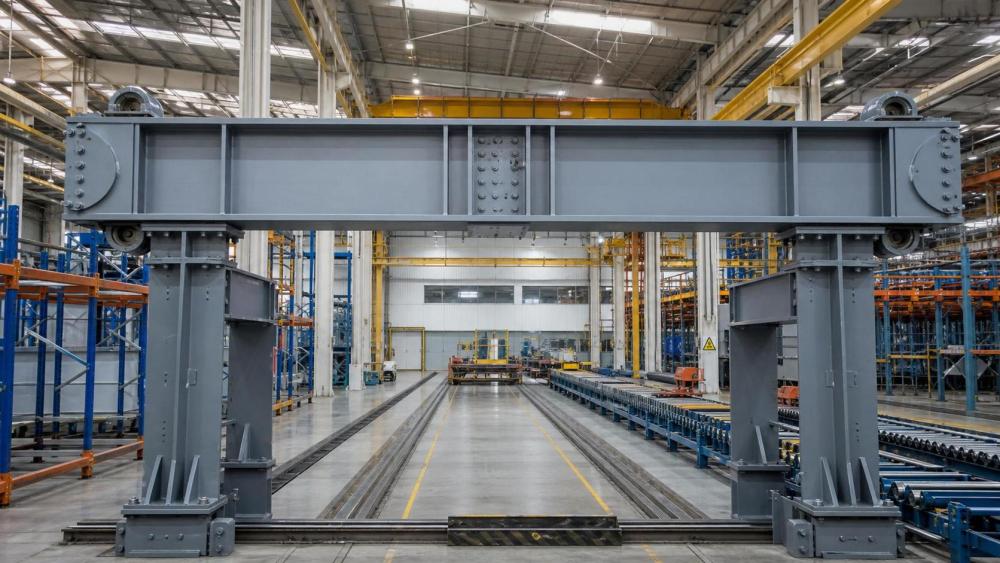
In material handling, that matters more than many teams admit. A forklift mast, crane girder, rack support, or conveyor structure rarely fails under textbook conditions.
It fails when real loads, real motions, and real tolerances drift away from assumptions. That is why structural mechanics load analysis is not just a calculation exercise.
It is also a test of engineering judgment. If the inputs are weak, the output may look precise but still be misleading.
For cranes, AS/RS steel structures, hoist supports, and port equipment, the model boundary is the first checkpoint. What is included changes the result dramatically.
A local component check may pass while the full system still has dangerous deflection, connection overload, or fatigue accumulation.
So the first question is simple. What exactly is being analyzed, and what has been excluded from the structural mechanics load analysis?
That question often reveals whether the engineering package is robust, or only presentation-ready.
Key Inputs That Control Structural Mechanics Load Analysis Results
Good structural mechanics load analysis depends on disciplined inputs. Most major result errors begin before meshing, solving, or reviewing stress contours.
The first input is load definition. Teams need to separate dead load, live load, payload, impact load, wind, seismic effects, braking force, and accidental overload.
That sounds basic, but many models still compress multiple realities into one static number. In actual operations, that shortcut creates blind spots.
The second input is load path. A force is not only about magnitude. It is also about where the force enters, spreads, concentrates, and exits.
For example, a bridge crane wheel load may be acceptable globally. Yet local web buckling or stiffener weakness may still trigger failure.
The third input is material behavior. Yield strength alone is not enough. Elastic modulus, ductility, weld behavior, temperature sensitivity, and fatigue properties also matter.
This becomes critical in cold warehouses, ports, and high-cycle automation systems. The same steel grade can perform differently across environments and duty profiles.
The fourth input is support condition. Ideal fixed supports rarely exist in production equipment. Bolted bases slip, rails settle, and anchors carry installation variation.
When supports are overconstrained in structural mechanics load analysis, stiffness rises artificially. That can hide real deflection and redistribute stress unrealistically.
The fifth input is geometry fidelity. Cutouts, weld toes, bracket transitions, and eccentric attachments can turn a safe average stress into a dangerous hotspot.
- Verify actual payload range, not only rated load.
- Check dynamic amplification during lifting, stopping, and turning.
- Use realistic contact areas and connection stiffness.
- Review manufacturing tolerances and misalignment effects.
- Match duty class to the intended life cycle.
When these inputs are collected carefully, structural mechanics load analysis becomes a decision tool, not just an approval document.
Common Assumptions and Where They Quietly Distort the Model
Every model uses assumptions. That is normal. The issue is not whether assumptions exist, but whether they are visible, justified, and tested.
Linear elastic behavior is one common assumption. It works well for early screening, but it can understate local plasticity near holes, welds, and connections.
Another assumption is static loading. In practice, forklifts brake abruptly, cranes sway, shuttles accelerate, and stacker cranes see repeated reversals.
If structural mechanics load analysis treats those events as steady loads, it may miss peak response and cumulative fatigue damage.
Connection idealization is another weak point. Engineers often simplify welds, bolts, pins, and bearing surfaces to save time. Sometimes that is acceptable. Sometimes it is not.
A simplified joint may predict smooth load transfer. The actual joint may carry prying, uneven preload loss, or secondary bending.
Boundary assumptions also deserve extra scrutiny. Rail-mounted systems, elevated structures, and floor-anchored supports depend on surrounding stiffness that is rarely perfect.
More importantly, assumptions should not stay hidden in appendix pages. They should be linked to risk, testing plans, and acceptance criteria.
A practical review table helps.
The best structural mechanics load analysis does not avoid assumptions. It exposes them and measures their impact.
Failure Risks That Deserve More Attention
Some failure risks are obvious, such as yield exceedance or excessive deflection. Others build quietly and only appear after commissioning.
Fatigue is one of the biggest examples. Repeated lifting, travel cycles, impact starts, and vibration can damage a structure that passes one-time load checks.
This is common in overhead cranes, sortation supports, shuttle rails, and mast structures. The load is not extreme once, but it is relentless.
Buckling risk is another area that gets underestimated. Slender columns, thin webs, and long compression members can fail before material yield becomes dominant.
Local instability also matters. Brackets, flanges, and welded transitions may wrinkle or deform even while the overall frame appears safe.
Then there is serviceability. Excessive deflection may not cause collapse, but it can misalign rails, disturb sensors, increase wear, or reduce picking accuracy.
That matters in smart intralogistics systems, where structural motion can affect software-controlled positioning and repeatability.
Connection failure deserves separate review. Weld roots, bolt groups, pin interfaces, and bearing plates often become the first weak link.
- Check fatigue categories for welded details.
- Review buckling modes, not only stress values.
- Set serviceability limits for alignment-sensitive systems.
- Inspect contact pressure and edge loading at joints.
- Consider accidental loading and misuse scenarios.
A mature structural mechanics load analysis covers these failure modes together. Looking at stress alone is rarely enough.
How to Judge Whether a Structural Mechanics Load Analysis Is Trustworthy
A credible review starts with traceability. Each major input should connect to drawings, duty assumptions, operating cases, and design standards.
Standards may differ by region and equipment type, but the logic is consistent. Loads, combinations, safety factors, and allowable responses must be defendable.
The next check is correlation. Has the structural mechanics load analysis been compared with hand calculations, prior designs, strain readings, or field behavior?
If not, the simulation remains an informed estimate. That can still be useful, but it should not be treated as final proof.
Sensitivity review is also essential. Small changes in support stiffness, impact factor, or connection behavior should not produce chaotic result swings without explanation.
When they do, the design may be too fragile, or the model may be underdefined. Either way, that is useful information.
Documentation quality is another signal. Clear load cases, mesh rationale, assumptions, acceptance limits, and failure mode discussion usually indicate stronger engineering discipline.
By contrast, polished screenshots without decision logic should raise caution.
- Confirm the operational load spectrum.
- Match the model to actual support and joint behavior.
- Review fatigue, buckling, and serviceability separately.
- Ask for sensitivity cases and validation evidence.
- Link findings to inspection and maintenance planning.
That final step matters in business terms. A strong structural mechanics load analysis supports procurement confidence, compliance readiness, and longer asset life.
In real projects, the best outcome is not a colorful stress plot. It is a structure that performs safely, predictably, and economically over time.
So when reviewing structural mechanics load analysis, focus on inputs, assumptions, and failure risks together. That is where sound engineering decisions are actually made.
Related News
- Can pallet racking be retrofitted for AS/RS integration in existing warehouses?Sep 11, 2026How does predictive maintenance reduce conveyor downtime? Discover how it ensures seamless AS/RS retrofit success—boosting uptime, ROI, and warehouse automation reliability.
- YLCSD350 Cutter Suction Dredger Specs That Matter in River and Port JobsAug 21, 2026YLCSD350 cutter suction dredger specs explained for river and port jobs—learn how pump, cutter, draft, wear design, and transport factors affect output, risk, and buying decisions.
- How to Evaluate Gantry Crane Structural Analysis for Load Cases and Deflection LimitsAug 06, 2026Crane structural analysis for gantry crane evaluation: learn how to verify load cases, stress results, and gantry crane deflection limits to compare suppliers, reduce risk, and choose a safer design.
- Heavy Load Handling Solutions: What to Compare for Steel, Machinery, and Mold TransportJul 15, 2026Heavy load handling solutions compared for steel, machinery, and mold transport. Discover how to assess safety, precision, routes, and total cost to choose the right system.